Guides7 minute read
How Heyball scoring works
Reds and colours, why the colours keep coming back, and how a frame actually ends. It is simpler than watching it suggests.
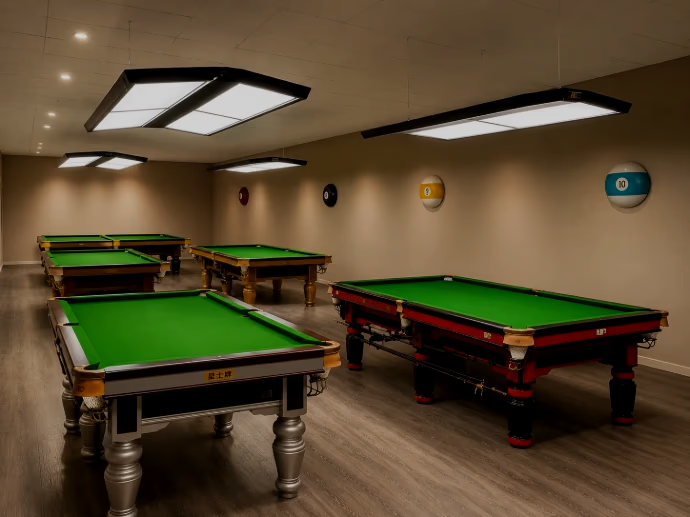
The table as it starts: fifteen balls racked on the foot spot with the black in the middle, and the cue ball anywhere behind the head string. If that looks like the pub game, it is the pub game. The table is what differs.
You already know the rules
Heyball is Chinese 8-ball, and Chinese 8-ball is eight-ball. Break, and whoever pots first takes that group, solids or stripes. Clear your seven, then pot the black to win. Call the black’s pocket. Pot it early, or pot it with a foul, and you lose the rack.
That is genuinely the whole thing. There is no scoring system to learn, no colours coming back on spots, nothing to add up. If you can play eight-ball you can play this tonight without reading another word.
Which raises the obvious question: if the rules are the same, why does the game look so different when good players play it?
Because the pockets are a third smaller
An American pool table gives a 57 mm ball a mouth of about 115 mm with square-cut jaws. A Heyball table gives the same ball about 85 mm, with jaws cut and rounded the way a snooker table’s are. On a pool table a ball arriving slightly off-centre clips a jaw and drops anyway. Here it clips the same jaw and comes back out.
Everything that feels hard about this game follows from that one number. Long pots stop being routine, pots down the rail become the hardest shot on the table, and you lose the ability to bully your way out of bad position.
And because the cloth has a direction
A pool table is usually worsted cloth, which plays the same whichever way you hit it. A Heyball table takes a napped cloth, like a snooker table: the fibres lie one way, and a slow cue ball drifts with them.
Firm shots barely notice. Slow ones do, which is exactly why a beginner’s first attempt at a safety finishes six inches from where they aimed it.
The balls, and which are yours
- 1
- 2
- 3
- 4
- 5
- 6
- 7
- 8
- 9
- 10
- 11
- 12
- 13
- 14
- 15
Seven solids, the black, seven stripes. You do not choose your group at the start — it is decided by the first ball legally potted after the break, and until then the table is open.
Fouls, and what they cost
The list holds no surprises:
- Potting the cue ball.
- Failing to hit one of your own group first.
- Failing to hit anything at all.
- Knocking a ball off the table.
- Potting the black before your group is cleared.
What differs is the penalty. Most Chinese 8-ball is played with ball in hand anywhere on the table after a foul, rather than the two shots an Australian pub gives you. That is far heavier than it sounds: a decent opponent handed the cue ball anywhere will often just clear up from there.
It is also why the game rewards safety so much more than pub eight-ball does. If there is no pot on, the right shot is usually to hit your ball thin, leave the cue ball tight on a cushion, and make your opponent find something.
How a rack ends
Call the pocket, pot the black, win the rack. Pot the black with the cue ball following it in and you lose instead, which is the ending that stings. A match is a number of racks rather than one — usually a race to a set number of wins, and the draw sheet will say.
Where the house rules live
Chinese 8-ball is a professional sport with a full rule book, and a club will use some of it and not all of it: what happens on a dry break, whether the break must be from behind the head string, how a re-rack is called. These vary, they are never worth an argument, and thirty seconds at the counter settles them before you start rather than in the middle of a rack.